
Heat Sinks
Performance of your heat sink design can be simulated & enhanced

Thermal simulation of heat sinks
We build a Conjugate Heat Transfer (CHT) thermal model of your heat sink design. Air and solid regions are modeled separately in our multi-region CHT approach, where heat transfer is calculated based on energy balance between air and solid regions. Heat convection and heat conduction can be simulated using our thermal model:
- An accurate thermal model is developed according to your application.
- CFD simulations are performed for various thermal conditions.
- Thermal resistance, Nusselt number and pressure drop of the heat sink are determined acording to the CFD results.
- Simulation results are post-processed and reported.

Benefits of thermal simulations
- Virtual Prototyping: Thermal simulations allow engineers to test and refine heat sink designs virtually before physical prototypes are built. This reduces development costs and time-to-market for IT devices.
- Performance Optimization: Simulations can predict the thermal performance of different heat sink designs under various operating conditions. This allows for optimization of fin design, material selection, and overall heat dissipation capabilities.
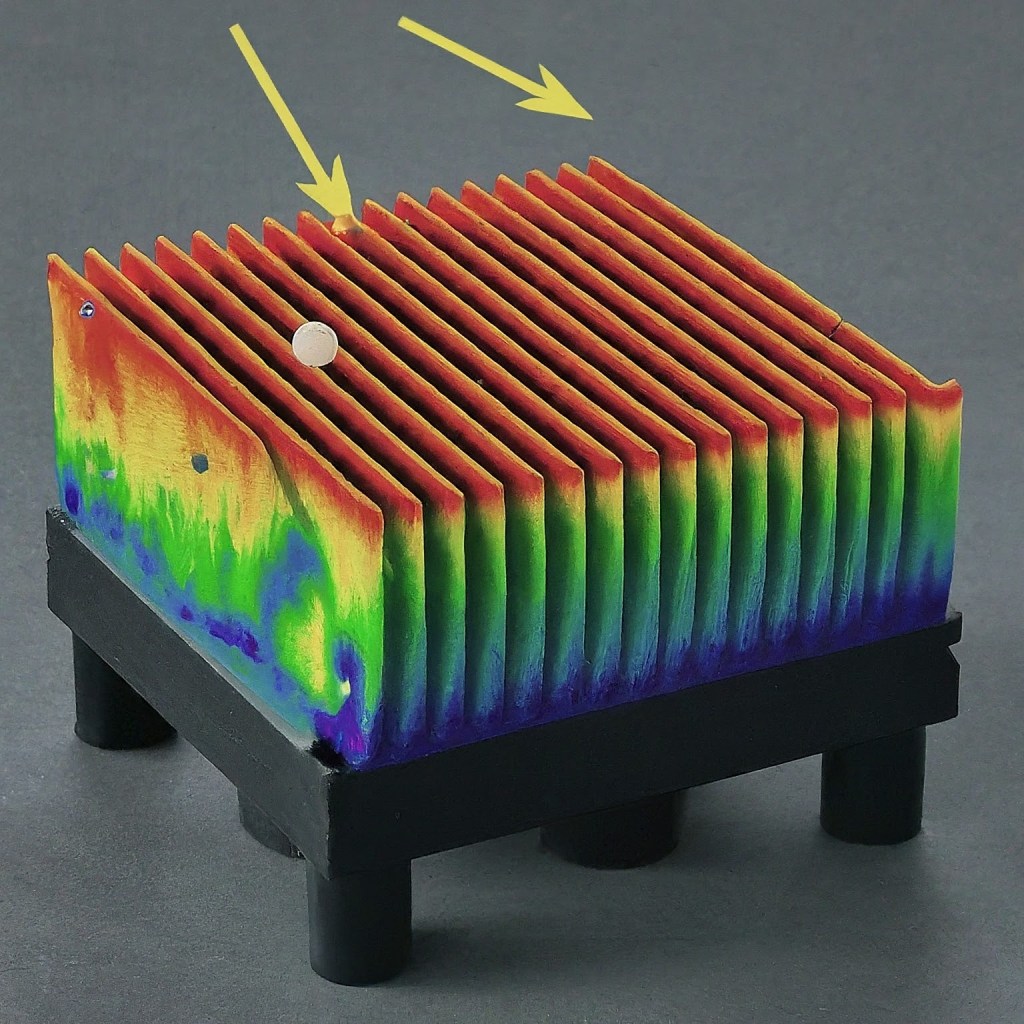
- Identifying Hotspots: Simulations can identify potential hotspots on the heat sink and surrounding components. This allows for targeted improvements in cooling strategies or component placement to prevent overheating.
Analyzing simulation results
- Temperature Distributions: Simulations provide visual representations (e.g., color maps) of temperature distribution across the heat sink and IT device components.
- Heat Flux Analysis: Heat flux values (rate of heat transfer) across different surfaces can be analyzed to identify areas requiring improved heat dissipation.
- Performance Metrics: Simulations can predict key performance metrics such as maximum operating temperature and thermal resistance of the heat sink.
Contact us for the CFD analysis of your heat sink design
Read our newsletter on the CFD simulations of heat sinks.

